If you’ve searched “AquaTru Carafe review,” you probably already own a pitcher filter and wonder if it’s doing enough. You want water free of lead, PFAS, and microplastics, but you don’t have room for a bulky under-sink system or the budget for full plumbing work.
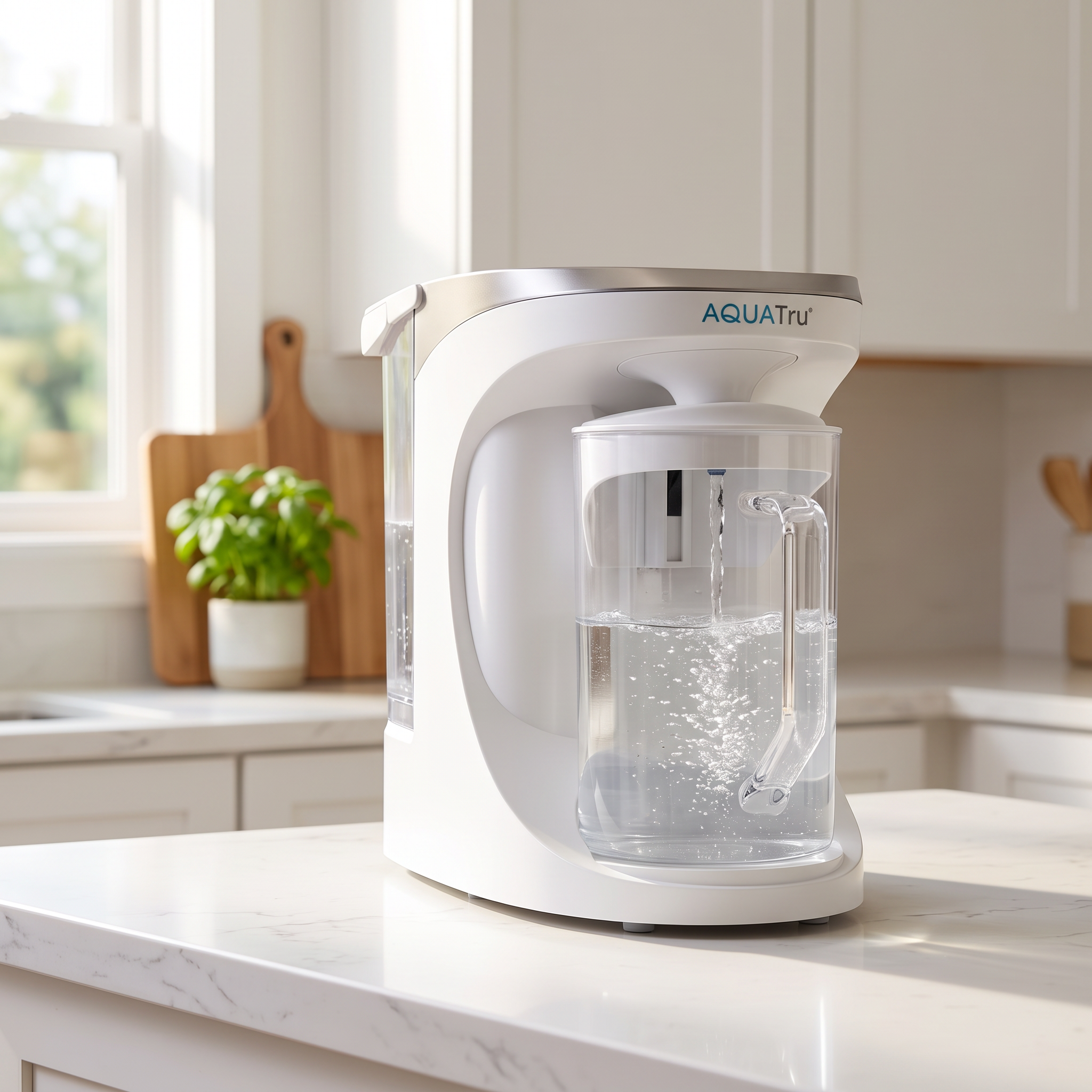
The AquaTru Carafe is a compact countertop reverse osmosis purifier designed to fill that gap. Based on the available lab testing, customer review data, and 2025-2026 award recognition, it largely delivers on the promise.
This article breaks down what it actually removes and how it compares to the larger AquaTru Classic and gravity filters like Berkey. We also cover what it costs to own long-term, and whether the current deals are worth acting on now.
Quick Review Summary
- Best For: Small households, apartments, and RV owners who want RO-quality water without installation
- Not Ideal For: Large families or anyone needing high-volume daily filtered water
- Main Benefit: Four-stage reverse osmosis removes the large majority of tested contaminants, per independent lab testing
- Biggest Limitation: Higher upfront cost than pitcher filters, plus some wastewater per fill cycle
- Current Price: $375.00 (financing available from roughly $31.25/month)
- Overall Verdict: A strong pick for space-constrained buyers who value glass construction and don’t need bulk capacity
Check the current AquaTru Carafe price
What Is the AquaTru Carafe?
The AquaTru Carafe is a countertop reverse osmosis water purifier made by Ideal Living, the same California company behind AirDoctor air purifiers. Founded in 2016 by Peter Spiegel and Kate Williams, the company built its AquaTru line around plug-and-play purification that skips permanent plumbing.
The Carafe is the smallest model in the lineup. It holds 0.5 gallons of purified water in a glass reservoir, compared with the 0.75-gallon plastic tank on the AquaTru Classic. Water runs through a mechanical pre-filter, a carbon filter, an ultra-fine RO membrane, and a VOC carbon stage before it reaches the carafe.
That four-stage process targets sediment, chlorine, heavy metals, nitrates, and volatile organic compounds, including PFOA and PFOS “forever chemicals.” The whole unit runs on a standard 120-volt wall outlet, weighs about 9 pounds, and measures roughly 14 by 7.5 by 13 inches.
AquaTru lists the Carafe at $375.00 on its official site, matching Walmart’s listing. The company advertises a 1-year limited warranty covering materials and workmanship, with customers responsible only for shipping fees on repairs or returns. A 30-day money-back guarantee is also referenced by third-party sources, though buyers should confirm exact current terms before ordering.
What Has Changed in 2026?
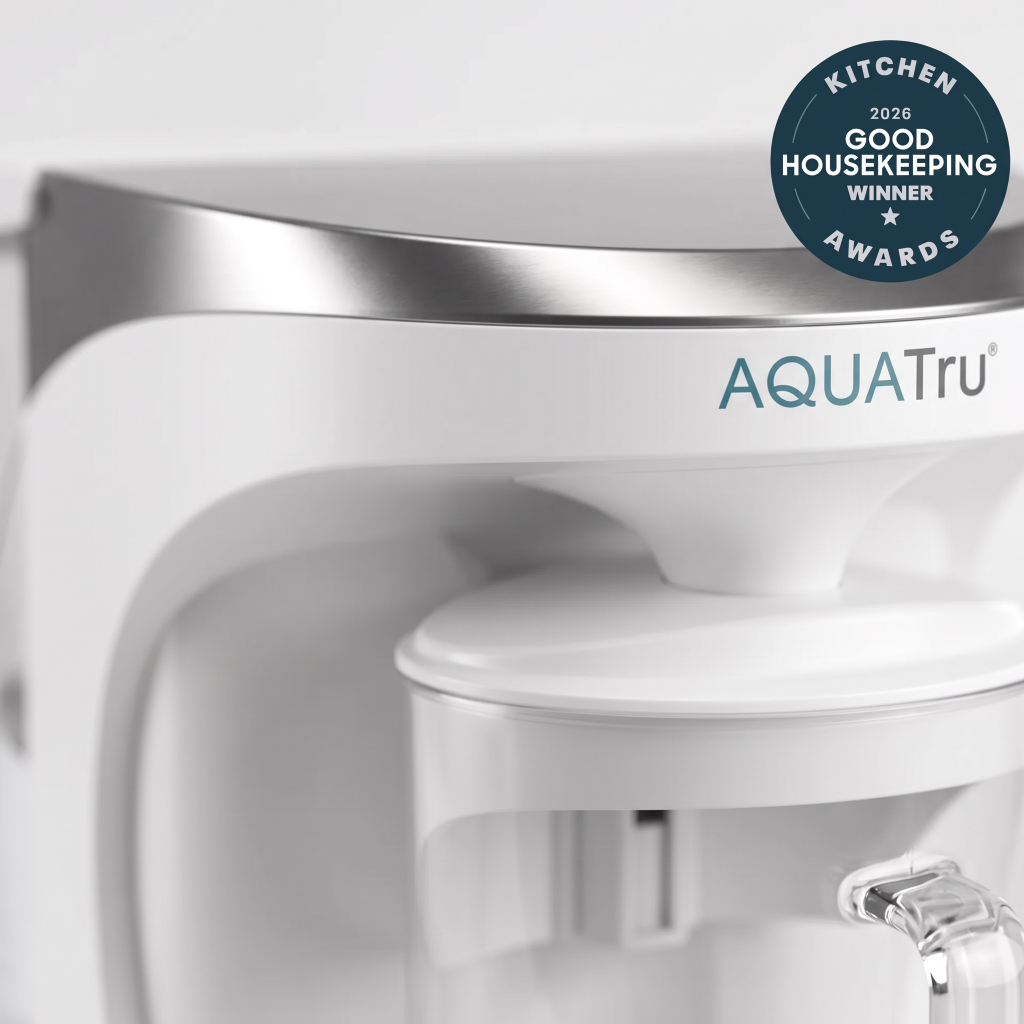
On November 13, 2025, Good Housekeeping named the AquaTru Carafe Smart a 2026 Kitchen Awards winner, and Esquire’s 2025 Gadget Awards called it the Best Water Purifier. Both are genuine, dated credibility signals that postdate most existing competitor reviews of this product.
Beyond the awards, nothing in the core product has changed. The filtration technology, contaminant list, and glass carafe design remain the same as of July 2026. Pricing promotions do fluctuate seasonally, so the 10% off offer mentioned here should be confirmed as current before you buy.
How We Evaluated the AquaTru Carafe
This review is based on independent research rather than hands-on testing. We reviewed AquaTru’s official product and warranty pages, along with third-party lab-testing data from WaterFilterGuru. We also looked at verified customer review sentiment published on AquaTru’s site, and real buyer feedback from Home Depot and the Better Business Bureau.
We also compared the Carafe against the AquaTru Classic, Berkey gravity filters, and standard pitcher filters like Brita and PUR to see where it genuinely fits. For readers researching options for small kitchens and RVs, our comparison of the best RV water filters“, covers systems built specifically for mobile use.
Who Is the AquaTru Carafe Best For?
- Singles or couples who don’t need multiple gallons of filtered water on hand at once
- Apartment or condo dwellers without space or permission for under-sink plumbing changes
- RV owners and full-time travelers who want plug-and-play purification without permanent hookup
- Anyone switching from a pitcher filter who wants documented reduction of lead, PFAS, and heavy metals
- Buyers who prefer a glass reservoir over plastic for taste and durability reasons
Who Should Probably Skip It?
- Large households needing several gallons of purified water daily should consider the larger AquaTru Classic instead
- Buyers on a tight budget who mainly want better-tasting water, not full contaminant removal, may be fine with a $30-50 pitcher filter
- Anyone in a drought-restricted area concerned about RO wastewater may prefer a non-RO gravity filter like Berkey
- Those who need very high daily throughput for cooking or a family may find refilling the smaller tank inconvenient
Key Features and Real-World Benefits
Four-Stage Reverse Osmosis Filtration
The Carafe pushes water through a pre-filter, carbon filter, RO membrane, and VOC carbon stage in sequence. Each stage targets a different contaminant category, from sediment to dissolved heavy metals to trace pharmaceuticals.
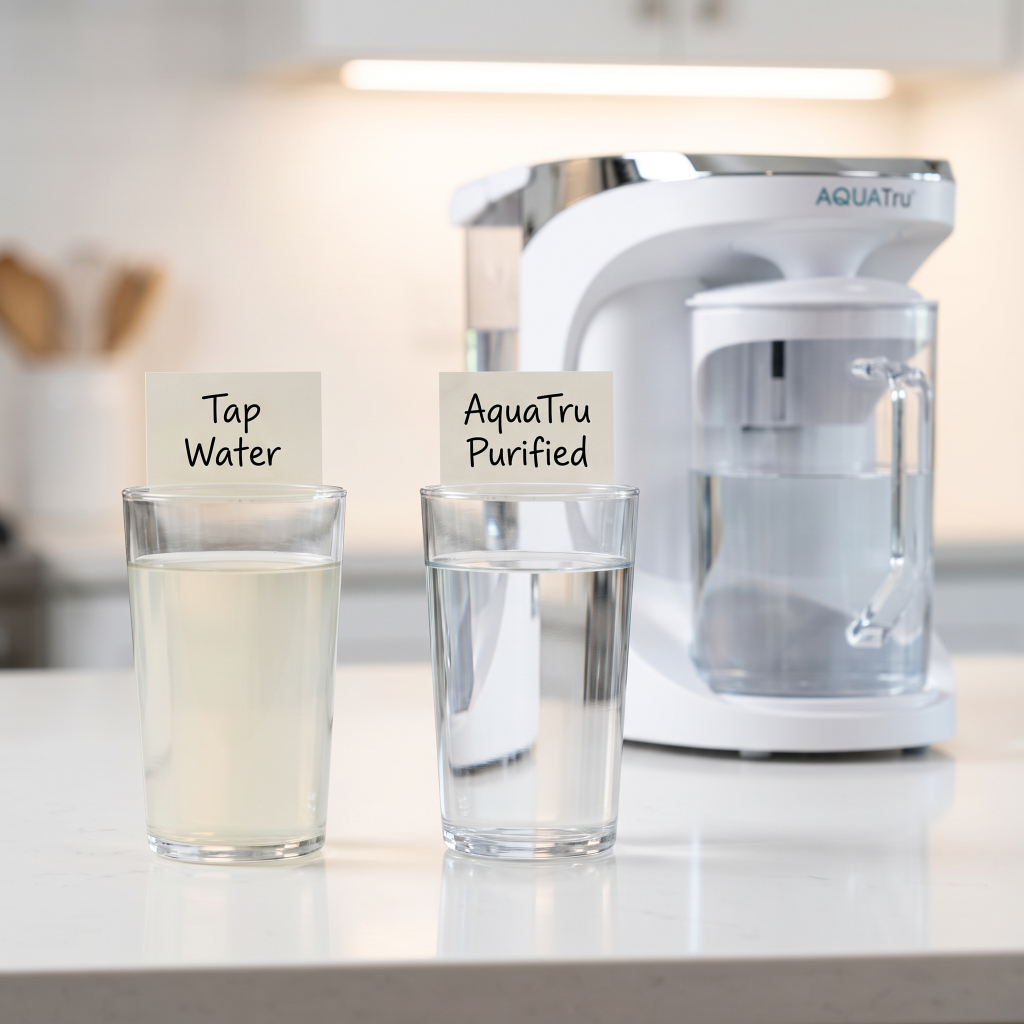
Independent lab testing by WaterFilterGuru found the Carafe eliminated 100% of 8 of 10 tested health-related contaminants, including uranium, fluoride, copper, and chloroform. The remaining two, barium and strontium, were still reduced by 89% and 91% respectively. That gave the Carafe the highest score WaterFilterGuru has recorded for a countertop RO system.
The practical benefit is water that’s measurably cleaner, not just better-tasting. Buyers focused specifically on lead or PFAS removal get documented third-party performance data, not just marketing language.
Glass Carafe and Compact Footprint
Unlike the plastic tank on the AquaTru Classic, the Carafe uses a glass reservoir that holds 0.5 gallons of purified water. Customer review data collected by AquaTru shows 5% of reviewers specifically praised the size as ideal for smaller kitchens.
The glass construction also means no plastic taste or leaching concerns during storage in the fridge. For apartment or RV counters where space is tight, the smaller footprint matters more than raw capacity.
Certification and Contaminant Claims
AquaTru advertises certification “to NSF standards,” which is a meaningful but specific claim worth understanding. The lineup is independently certified to NSF/ANSI 42, 53, 58, 401, and 372 by IAPMO R&T, a recognized certification body. That’s different from being tested directly by NSF International itself.
That distinction doesn’t diminish the real-world performance shown in lab testing. But buyers should know “certified to NSF standards” and “NSF certified” aren’t identical claims. AquaTru states the system removes 84 harmful contaminants from tap water based on this certification testing.
Plug-and-Play Setup, No Plumbing
The Carafe runs off a standard wall outlet with no permanent water line connection required. You fill the tap water tank manually, and the unit processes it through the four filtration stages automatically.
This is the feature that makes the Carafe genuinely useful for renters, RV owners, and anyone who can’t or doesn’t want to modify existing plumbing. Setup involves unboxing, rinsing filters per instructions, and plugging it in.
Product Performance and Available Evidence
Effectiveness and Taste
Water quality is the standout theme across verified reviews. AquaTru’s own published customer data shows 48% of reviews specifically praise water quality as delicious, exceptional, clean, or great. Another 16% single out taste specifically.
Independent lab testing backs this sentiment with measurable contaminant reduction numbers rather than just subjective praise. The combination of documented removal rates and consistent taste feedback gives buyers more confidence than taste claims alone.
Ease of Use and Setup
Reviewers and competitor testers describe the setup as straightforward, with automatic controls and infrequent maintenance beyond scheduled filter swaps. AquaTru’s own data shows 8% of reviewers specifically highlighted system quality and ease of use as reasons they recommend it.
Realistically, you’re manually refilling the tap water tank rather than connecting to a line, so it does require more hands-on attention than an under-sink system.
Wastewater Per Cycle
This is a legitimate limitation worth weighing before you buy. Reverse osmosis systems generally waste some water during filtration, and at least one Home Depot reviewer described discarding almost half a tank with every fill after running water through the recommended four cycles.
If you live somewhere with drought restrictions or pay for metered water, this is worth factoring into your decision. It’s not unique to AquaTru. Most RO systems share this tradeoff for the sake of contaminant removal.
Ongoing Filter Costs
The pre-filter and carbon filter last about 6 months or 300 gallons. The RO filter lasts roughly 1 year or 600 gallons, and the VOC carbon filter lasts about 1 year or 300 gallons. Carafe filters are unique to this model and aren’t interchangeable with Classic or under-sink filters.
Exact current filter pricing should be checked directly on AquaTru’s replacement filters page before you buy, since costs can shift and weren’t independently confirmed at the time of this research.
Customer Support
Most published sentiment is positive, but a few documented complaints exist and deserve fair mention. One BBB complaint described a Carafe purchased in late December 2025 that stopped working within about ten weeks. The customer was frustrated with how the support ticket was handled.
A separate BBB complaint involved a wrong item shipped with difficulty getting an expedited replacement. These appear to be isolated service experiences rather than evidence of a widespread defect, but they’re worth knowing before you purchase.
Pros and Cons
- Pro: Independently tested to eliminate 100% of 8 of 10 major contaminants, with strong reduction on the remaining two
- Pro: Glass reservoir and compact size fit small kitchens, apartments, and RVs
- Pro: No plumbing or installation required, just a standard wall outlet
- Pro: Strong verified customer sentiment on taste and water quality
- Pro: Recent Good Housekeeping and Esquire award recognition adds third-party credibility
- Con: $375 upfront cost is significantly higher than pitcher filters
- Con: Produces wastewater per filtration cycle, a concern in drought-prone areas
- Con: Smaller 0.5-gallon capacity means more frequent refills for larger households
- Con: A handful of documented BBB complaints about unit failures and support responsiveness
Price and Overall Value
The AquaTru Carafe currently lists at $375.00. Financing options bring that down to around $31.25 per month for those who prefer to spread the cost. That’s meaningfully less than the AquaTru Classic, priced around $475, but well above a $30-50 pitcher filter.
Whether it’s worth it depends on what you’re solving for. If your goal is documented removal of lead, PFAS, and heavy metals in a small footprint, the Carafe delivers real value. A basic pitcher filter simply can’t match that. If you just want better-tasting water and don’t need certified contaminant removal, a cheaper pitcher filter covers that narrower need.
Long-term costs include periodic filter replacements on top of the initial purchase. Budget for that ongoing expense rather than treating $375 as a one-time cost.
A current 10% off offer can meaningfully reduce the entry price. Confirm it’s still active, and check whether bigger seasonal sales are imminent before finalizing a purchase.
See current AquaTru Carafe discounts
How the AquaTru Carafe Compares With Alternatives
| Product | Best For | Current Price | Main Advantage | Main Limitation |
|---|---|---|---|---|
| AquaTru Carafe | Small households, apartments, RVs | $375.00 | Compact glass reservoir, no plumbing required | Smaller 0.5-gallon capacity |
| AquaTru Classic | Families needing more water volume | ~$475 | Larger 0.75-gallon tank with the same RO filtration technology | Larger countertop footprint |
| Berkey Gravity Filter | No-electricity households | Varies by size | No electricity required and no wastewater produced | Not true reverse osmosis; fewer contaminant certifications |
| Brita/PUR Pitcher Filter | Budget-conscious buyers wanting better tasting water | $30–50 | Very affordable with no installation required | Primarily removes chlorine; limited reduction of lead and PFAS |
If you need more daily volume for a family, the Classic’s larger tank justifies its higher price without sacrificing filtration quality. If you’re drawn to Berkey because you’ve owned one before, know that some AquaTru switchers moved away from gravity filters. They cited metallic taste and bulk as their main reasons.
Pitcher filters remain the cheapest entry point. Most only address chlorine taste, though, rather than the broader contaminant list the Carafe is certified against. For readers weighing compact purifiers specifically for travel, our review of the GoBlueTech AR3 RV water filter offers a direct point of comparison for mobile setups.
Customer Complaints and Important Limitations
The dominant theme in verified reviews is positive: strong marks for water quality, taste, and system ease of use. That said, a few documented complaint patterns deserve honest mention rather than being buried.
- Wastewater per cycle: a recurring, legitimate concern shared across most RO systems, not unique to AquaTru; one buyer described discarding roughly half a tank per fill
- Isolated support complaints: BBB records show individual cases of a unit failing early and a ticket handled poorly, plus a wrong-item shipping mix-up; these read as isolated service gaps, not confirmed systemic defects
- No confirmed recalls or safety issues: no evidence surfaced of a widespread mechanical failure or safety recall specific to the Carafe
Frequently Asked Questions
Does the AquaTru Carafe really remove PFAS, lead, and microplastics?
Yes, based on independent lab testing that found it eliminated 100% of 8 of 10 tested health-related contaminants. The VOC carbon stage specifically targets PFOA and PFOS “forever chemicals,” while the RO membrane addresses lead and other heavy metals. Barium and strontium were reduced but not fully eliminated in testing.
How much does the AquaTru Carafe cost, and is the 10% discount worth waiting for?
The Carafe currently lists at $375.00, and a 10% off offer can lower that entry cost. Seasonal promotions from AquaTru have historically included larger sales around early September, so buyers with flexible timing may want to confirm whether a bigger discount is coming before purchasing at 10% off.
How is the Carafe different from the AquaTru Classic, and which should I buy?
The Carafe holds 0.5 gallons in a glass reservoir, while the Classic holds 0.75 gallons in a plastic tank. Both use the same four-stage filtration technology. Choose the Carafe for smaller households or tight counter space, and the Classic if you need more volume for a family.
How much wastewater does the AquaTru Carafe produce per cycle?
Exact figures weren’t independently verified for the Carafe specifically, but RO systems generally waste some water during filtration. At least one reviewer described discarding close to half a tank per fill, which buyers in drought-prone areas should weigh carefully.
Is the AquaTru Carafe good for small kitchens, apartments, or RVs?
Yes, its compact 14×7.5×13-inch footprint and standard wall-outlet power make it well suited to these settings. No plumbing modification is required, which is exactly what renters and RV owners typically need.
Is the AquaTru Carafe actually NSF certified?
Not exactly. It’s certified to NSF/ANSI standards 42, 53, 58, 401, and 372 by IAPMO R&T, an independent certification body, rather than tested directly by NSF International. This is a meaningful distinction, though the underlying performance testing still supports AquaTru’s contaminant removal claims.
Final Verdict
The AquaTru Carafe is a compact, plug-and-play reverse osmosis purifier. It delivers independently documented contaminant removal in a footprint small enough for apartments and RVs.
Its strongest benefit is measurable water quality, backed by both lab testing and consistent customer sentiment. Its biggest limitation is the tradeoff between upfront cost and the wastewater inherent to RO filtration.
The Carafe makes sense over the larger Classic if you don’t need extra volume. Compared with pitcher filters, it’s worth the extra cost when certified contaminant removal matters more than price. The November 2025 Good Housekeeping and Esquire awards add real third-party validation that wasn’t available to earlier reviews.
Based on the evidence, the AquaTru Carafe is a solid buy for the small-household, apartment, or RV buyer it’s built for. The current 10% off offer makes now a reasonable time to consider one.
How We Review: At Time to RV, we only recommend products and places we have personally used or visited. Our reviews are based on real-life testing during our full-time travels. We never accept payment for a positive review; our goal is to give you the honest truth so you can hit the road with confidence.