Key Takeaways
- GlacierFresh offers the best balance of price, flow rate, filtration capability, size, and long-term cost, making it the top pick.
- BluTech provides a rugged, metal-framed system with stainless components and a weather guard, ideal for those prioritizing build quality.
- Clearsource Ultra is best for those needing maximum protection, especially in areas with questionable water sources, due to its VirusGuard filtration.
GlacierFresh vs BluTech vs Clearsource
Why I Tested Three Different RV Water Filters
One thing I’ve learned after full-time RVing across the country is this: every campground has different water… and some of it is rough. We’ve hooked up to everything from crystal-clear well water to water that smelled like a swimming pool, tasted like metal, or had visible sediment. After a few too many surprises, upgrading our water filtration setup became a priority for our family.
Over the past year, we’ve tested three of the most popular 3-stage RV water filtration systems on the market:
- GlacierFresh RV 3-Stage System (AUQAGO)
- BluTech AR3 3-Stage Water Filtration System
- Clearsource Ultra™
All three claim premium filtration, strong performance, and RV-friendly design, and honestly, they’re all great systems in their own ways. But after testing them side by side at multiple campgrounds, comparing flow rates, dealing with real-world hookups, and living with each system day to day, one system clearly fit our needs best.
In this review, I’m sharing my honest experience with each filter, what I loved, what I didn’t, and which one ended up becoming our main system based on price, filtration capabilities, water flow, low-profile design, and long-term replacement cost.
Let’s jump in.
Table of Contents
Meet the Three Filters in My Setup
Before I dive into performance and comparisons, here’s a quick look at each of the RV water filtration systems I’ve personally used. All three are 3-stage systems designed for RVers, but each one approaches filtration, design, and usability a little differently.
GlacierFresh RV Water Filter System (AUQAGO 3-Stage)

The GlacierFresh system was the newest addition to our setup, and right away, I noticed how compact and lightweight it is. It uses the same 5-inch filter size as BluTech, which means it’s extremely low-profile and easy to handle, something I appreciate when our wet bay is already packed with gear.
Despite the smaller size, GlacierFresh still offers 0.2-micron filtration, which is one of the tightest levels of filtration available for RV water filters. It’s a true 3-stage system with sediment, carbon, and high-flow submicron filtration, and we noticed right away that it produced the strongest water flow of all three systems we tested.
It also weighs just around 10 lbs, making it effortless to store or move on travel day. And at around $299.99, it comes in significantly cheaper than the other two, with lower-cost replacement filters as well.
BluTech AR3 3-Stage RV Water Filtration System

We’ve used BluTech for quite a while, and it’s a system we’ve always spoken highly of. The AR3 is also a 0.2-micron, 3-stage system, so filtration-wise, it’s on the same level as GlacierFresh. The frame is made of electroplated aluminum, the canisters are stainless steel, and the entire system feels rugged and built for RV life.
One thing BluTech includes that the others don’t is a weather guard, which comes standard in the price. If you leave your system outside or travel a lot through harsh conditions, that’s a nice bonus. It’s also very compact and lightweight, just slightly smaller than the GlacierFresh system overall.
At $499.99, it’s a solid mid-range premium option with excellent build quality and strong performance, just at a higher price point.
Clearsource Ultra™ RV Water Filter System
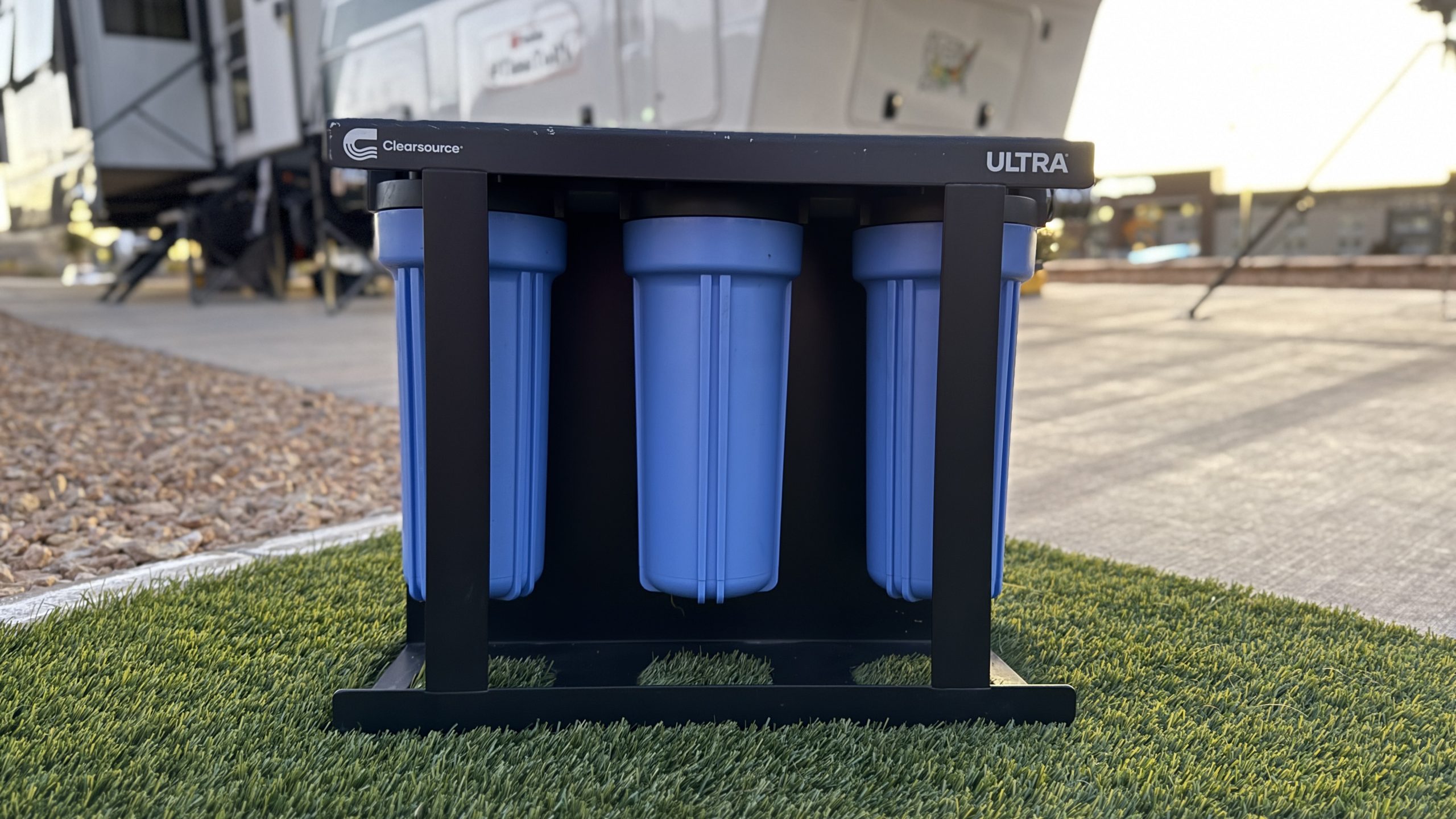
The Clearsource Ultra is the tank of the group, both in filtration and in physical design. It uses a triple-stage setup with a VirusGuard™ filter in the final stage, adding an extra layer of protection against bacteria, cysts, and viruses. If you prioritize maximum contaminant removal, this system definitely has the most advanced filtration stack.
But all that performance comes with trade-offs: the system is extensive, weighs close to 28 lbs, and uses 10-inch filters rather than the compact 5-inch style. It’s also the most expensive of the three at around $599.99, and the weather guard is sold separately for anywhere from $80 to $300, depending on the version you want.
Clearsource feels like an industrial-grade setup, and for RVers wanting the heaviest-duty build and the highest level of pathogen protection, it’s a strong contender.
Filtration Performance: What the Water Actually Tastes Like
When it comes to RV living, water quality can swing wildly from campground to campground. We’ve hooked up to everything from crystal-clear mountain well water to water that smelled like bleach or tasted as if someone stirred it with a rusty spoon. So filtration performance isn’t just a “nice to have”, it genuinely affects our daily life.
Here’s what I noticed after using all three systems in real-world conditions.
GlacierFresh vs BluTech: Same Filtration Power, Same Micron Rating
Both GlacierFresh and BluTech use a 0.2-micron final filter paired with sediment and carbon stages. On paper, these two systems offer the same filtration capabilities, and in practice, the water tasted identical: clean, crisp, and without any brewery-metallic or chlorine aftertaste.
I never once questioned drinking from the tap with either of these systems connected. Coffee tasted better, food tasted cleaner, and even brushing my teeth didn’t come with that “campground aftertaste.”
Clearsource Ultra: Extra Pathogen Protection
The Clearsource Ultra adds something the other two don’t, their VirusGuard™ third stage. It’s designed to remove or reduce bacteria, cysts, and viruses. So if you camp off-grid, use questionable water sources, or travel through areas where you’re worried about microbial contaminants, Clearsource gives a different level of peace of mind.
Taste-wise, the water was also great, clean, neutral, no chemical notes and no sediment.
Could I Taste a Difference Between the Three?
Honestly? Not really.
All three produced clean, great-tasting water that I felt safe drinking. The most significant difference for me wasn’t flavor; it was flow rate, convenience, and long-term cost.
Where Filtration Matters Most (My Experience)
- Water with heavy chlorine → all three systems handled it well.
- Water with visible sediment → GlacierFresh and BluTech caught it quickly; Clearsource did too, but you can “feel” the more restrictive micron level in the VirusGuard stage.
- Hot showers → extremely important to have a filter that doesn’t throttle pressure (more on this in the next section).
- Using the RV’s ice maker & fridge water → no chemical taste with any system.
In short, filtration quality was a win across the board, but for everyday RV living, there was no noticeable taste advantage that would justify spending more unless you specifically want the virus-level protection that Clearsource provides.
Water Pressure & Flow Rate: Showers, Dishes, and Daily RV Life
If there’s one thing that can ruin a good shower in an RV, it’s a water filter that chokes the flow. We’ve been at campgrounds where the pressure is already mediocre, so the last thing I want is a filtration system that restricts it even more.
Out of all the differences between these three filters, water flow was the one I noticed the fastest.
GlacierFresh: The Highest Flow Rate of All Three
Right away, GlacierFresh stood out because the water pressure felt the most natural, almost like being hooked directly to the spigot (just with way cleaner water).
Whether we were:
- taking showers
- washing dishes
- doing laundry
- or filling the fresh tank
…the GlacierFresh system kept strong, steady pressure every time.
This was especially noticeable at campgrounds with lower incoming pressure. GlacierFresh simply didn’t bottleneck it the way some other systems can.
BluTech AR3: Strong, Reliable Pressure
BluTech also performed well in the pressure department. Their “High Flow” filter design does exactly what it claims to do, and we never felt like showers or faucets were being noticeably restricted.
It wasn’t quite as fast as the GlacierFresh in our setup, but still one of the strongest high-end filters we’ve used.
If GlacierFresh didn’t exist, BluTech would be my top performer for flow.
Clearsource Ultra: Good Pressure, But You Can Feel the Restriction
Clearsource’s flow is still solid, definitely better than cheaper inline filters, but it was the most restrictive of the three.
Part of that is because the Ultra uses:
- larger 10-inch canisters
- and a more protective third-stage VirusGuard filter
That extra layer boosts filtration power, but it also slows things down a bit.
It’s nothing dramatic, but when you run multiple fixtures or fill your tank, you notice it.
Real-World Comparison in Our Brinkley
- Shower while someone washes hands?
- GlacierFresh: no issue
- BluTech: slight dip
- Clearsource: most noticeable dip
- GlacierFresh: no issue
- Filling our fresh tank:
- Fastest → GlacierFresh
- Middle → BluTech
- Slowest → Clearsource
- Fastest → GlacierFresh
- Campgrounds with low pressure:
- GlacierFresh made the most significant difference; the others felt more restrictive.
Bottom Line on Flow
If water pressure is a priority (and in an RV, it usually is), GlacierFresh was the clear winner for us.
BluTech was close behind, and Clearsource performed well, but with a more noticeable reduction during heavy use.
Filter maintenance is an important part of any RV safety tips checklist for your plumbing.
Build Quality, Size, and Weight: How Each Filter Fits Into Real RV Life
A water filter can have impressive specs on paper, but if it’s bulky, heavy, or awkward to store in an RV, it quickly becomes a headache. After using all three of these systems in our Brinkley, the differences in build and usability became really obvious.
Here’s how each one stacks up in terms of materials, durability, size, and day-to-day handling.
GlacierFresh: Lightweight, Compact, and Easy to Manage
One of the first things that impressed me about GlacierFresh was its lightness and low profile. The frame is made from a polycarbonate carbon-fiber blend, and the filters are the smaller 5-inch size, which means:
- It’s extremely easy to carry
- Fits comfortably in our wet bay
- Doesn’t take up precious storage space
- And it is simple to move on travel day
It weighs around 10 lbs, which is significantly lighter than Clearsource and slightly lighter than BluTech.
Despite the lightweight design, the system still feels sturdy. Nothing rattles, nothing flexes, and the quick connects feel solid.
This is the one I least mind lifting, storing, or repositioning, and that matters more than I expected.
BluTech AR3: Rugged, Compact, and Built for RVers
The BluTech AR3 also uses 5-inch filters, which gives it the same compact footprint as GlacierFresh. The difference is in the materials:
- Electroplated aluminum frame
- Stainless steel canisters
- Stainless quick-connect fittings
It looks and feels incredibly durable, definitely built for long-term outdoor exposure.
BluTech also manages to keep the system lightweight despite the metal components, coming in at just over 8 lbs. This surprised me, because it looks heavier than it is. Handling it is easy, and it fits perfectly in the wet bay without needing extra space or rearranging.
This system has the most “premium rugged” feel of the three. If durability is someone’s top priority, BluTech nails that category.
Clearsource Ultra: Heavy-Duty Construction… and Heavy, Period
Clearsource approaches filtration completely differently. The Ultra is built on a powder-coated metal chassis with large 10-inch canisters and stainless fittings. It feels industrial, because it basically is.
But all that durability comes with trade-offs:
- The system weighs nearly 28 lbs
- It’s much larger and harder to carry
- It doesn’t easily fit inside many RV wet bays
- It typically ends up sitting outside on the ground (making the optional cover more important)
This is, by far, the bulkiest of the three, something you really feel when moving it during setup or teardown.
If you want the most robust, “tank-like” setup, Clearsource is it. But if you prioritize portability or storage, size and weight are definitely worth considering.
How They Fit in My Brinkley 3610
- GlacierFresh: fits with the least effort, is easiest to manage, and has the smallest footprint.
- BluTech AR3: also fits perfectly; compact but with a more rugged build.
- Clearsource Ultra: too bulky for the wet bay, so it usually lives outside the rig when we’re hooked up.
My Bottom Line on Build & Size
All three are well-built systems, but they’re designed for very different types of RVers.
- If you want the lightest, easiest-to-store system → GlacierFresh
- If you want premium metal construction without the bulk → BluTech AR3
- If you want the most heavy-duty system on the market → Clearsource Ultra
Weather Protection & Covers: What Happens When These Systems Live Outside
Depending on how you camp, weather protection may matter a lot… or not at all. We’ve stayed in everything from freezing temps to nonstop Florida rain, so I’ve had plenty of chances to see how each system handles the elements.
Here’s how GlacierFresh, BluTech, and Clearsource compare when it comes to covers, durability outdoors, and protection.
BluTech AR3: Weather Guard Included
One of BluTech’s biggest bonuses is that it comes with a weather guard already included in the price.
That means:
- You don’t pay extra
- You don’t have to hunt for a compatible cover
- And the system is naturally more protected from the sun, rain, and road dust.
The guard is durable, fits well, and makes me feel better when the system has to sit outside our wet bay during certain setups.
If weather protection is essential to you, this inclusion adds real value, especially compared to Clearsource, where the cover is a separate purchase.
Clearsource Ultra: WeatherGuard Sold Separately
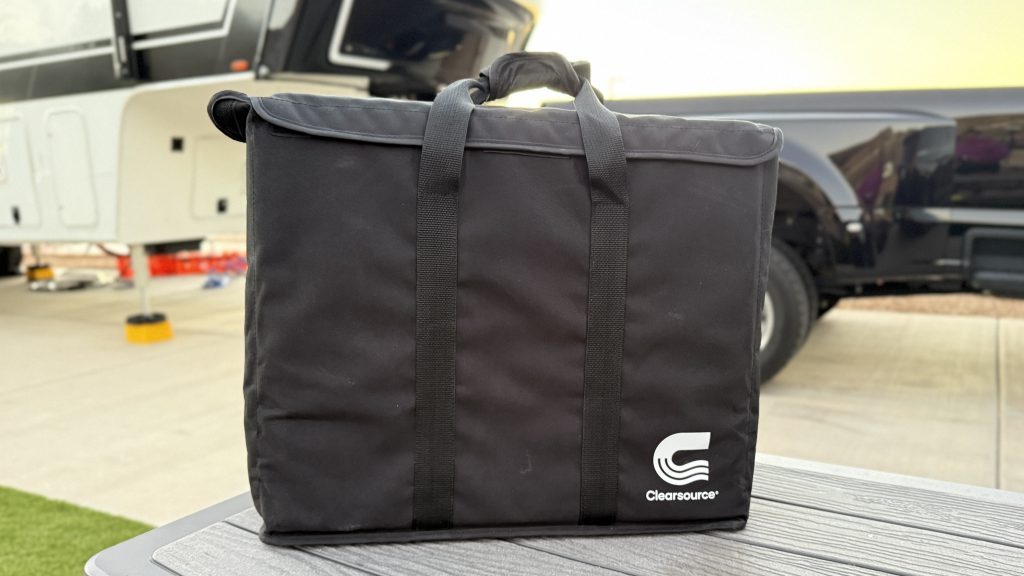
Clearsource offers multiple WeatherGuard cover options, but none come included with the system.
Depending on the version you choose, covers range from around $80 to $300, which is a significant extra cost on top of an already premium-priced filter.
The reason you may want one is because:
- The Ultra is large
- It often lives outside the RV
- And the metal chassis can get weather-beaten over time
If you camp somewhere with intense sun, heavy rain, or winter conditions, the cover becomes more of a necessity than an accessory.
GlacierFresh: No Cover Offered (But Also Smaller + Easier to Store)
GlacierFresh doesn’t currently offer a branded cover, which might be a downside for some RVers.
That said, the GlacierFresh system is:
- Compact
- Lightweight
- Easy to store inside the wet bay or a bin
- Not usually left exposed like Clearsource
In our rig, the GlacierFresh tucks right into the bay, completely protected without needing an external cover. So while they don’t offer one, its low-profile design makes it easy to keep out of the elements anyway.
If you want to leave it outside, you could use a small generic cover or place it under your rig skirt or tote.
My Real-Life Take
Here’s how weather protection landed for us:
- BluTech wins if you want built-in protection without extra cost.
- Clearsource loses points for selling a pricey cover separately, though it’s almost necessary because the unit usually lives outside.
- GlacierFresh doesn’t need a cover for us because it fits indoors, but if someone’s setup requires leaving it outside, they’d need a workaround.
Installation & Everyday Use: Hookups, Maintenance, and Filter Changes
A water filter can be incredibly effective, but if it’s a pain to set up or maintain, you feel it every single travel day. After using all three systems at multiple campgrounds, here’s how each one performed during installation and everyday use.
GlacierFresh: Easiest to Set Up and Move Around
GlacierFresh was by far the easiest system for me to install the first time, and every time after that. It’s lightweight, compact, and the stainless steel quick-connect fittings make it very user-friendly.
What I love most:
- Tool-free installation
- Quick connects snap in smoothly
- The system doesn’t feel awkward or heavy to position
- Easy to lift and store on travel days
- Zero learning curve, if you’ve ever hooked up a hose, you can install this
It also sits comfortably in our Brinkleys’ wet bay, meaning I rarely have to leave it exposed or move it around once we’re parked.
Filter changes were simple, clean, and inexpensive compared to the other two systems.
BluTech AR3: Smooth Setup with Premium Quick Connects
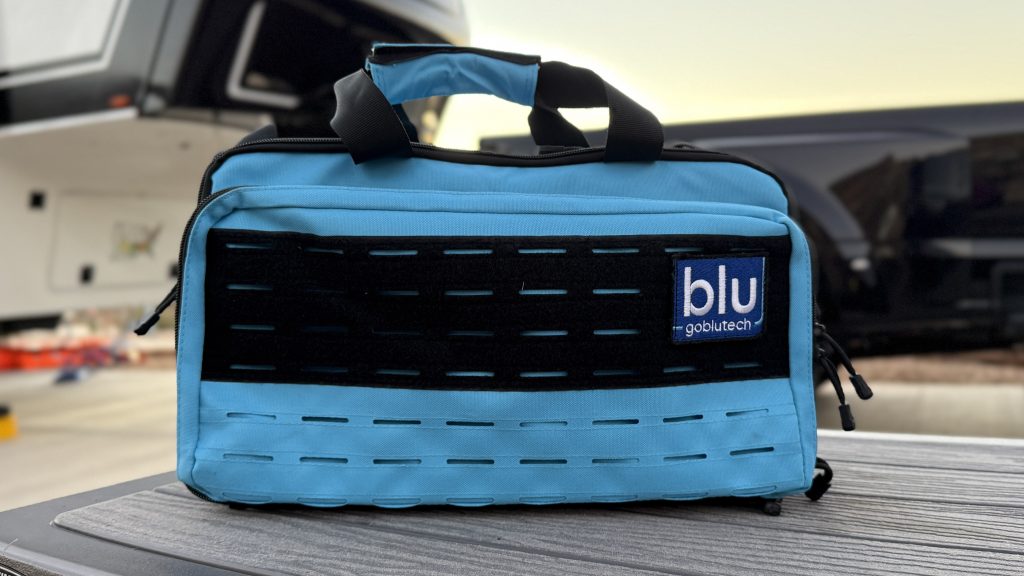
BluTech also installs very easily and is definitely designed for RVers. Their stainless steel quick-connects are high-quality, and the lightweight frame makes it simple to pull in and out of storage.
Here’s what stood out:
- Clean, intuitive setup
- Quick connects feel solid and durable
- Weather guard doesn’t interfere with hookups
- Compact size makes the whole unit easy to handle
Filter changes are straightforward, though BluTech replacement filters cost more than GlacierFresh. Still, the process itself is smooth.
Clearsource Ultra: The Most Involved Setup (But Not Difficult)
Clearsource uses a larger, heavier frame, so setup takes a little more effort due to the weight and size. It’s not difficult; it just requires more lifting, maneuvering, and outdoor placement.
Key notes:
- Heaviest system to carry and position
- Larger footprint means it rarely fits inside RV wet bays
- Often needs to be placed outside on the ground or on a stand
- Weather cover (if purchased) adds an extra step
- Uses garden hose connections rather than quick-connect fittings
Filter changes are easy enough, but the 10-inch canisters mean more weight and bulk when swapping them out. Replacement filters also cost more than GlacierFresh and BluTech.
Daily Convenience: The Big Difference
When you’re moving campsites often or using your filtration system every single day, small conveniences matter.
For us:
- GlacierFresh was the quickest, easiest, and least labor-intensive to use.
- BluTech was also convenient but slightly bulkier in feel.
- Clearsource Ultra required the most moving, lifting, and outdoor setup.
My Bottom Line on Installation & Everyday Use
- If ease of use and installation matter most → GlacierFresh wins.
- BluTech is a close second and still very RV-friendly.
- Clearsource is manageable, but its weight and size make it the least convenient for frequent movers or smaller rigs.
Price, Replacement Costs & Overall Value (Why GlacierFresh Is My Top Pick)
After testing all three systems, it became really clear that while each brand offers solid filtration and quality, the overall value varies significantly. When you combine upfront price, flow rate, filter performance, long-term maintenance, and size, one system stood out for us, and that was GlacierFresh.
Here’s how the numbers and real-world experience break down.
Upfront Pricing (Approximate at the time of writing)
- GlacierFresh RV 3-Stage System: $299.99
- BluTech AR3: $499.99
- Clearsource Ultra: $599.99
Right away, GlacierFresh comes in at the lowest price, and not by a small margin. It’s nearly $200 cheaper than BluTech and $300 cheaper than Clearsource.
Considering that all three provide premium filtration, the price gap becomes a significant factor.
Replacement Filter Costs
Anyone with full-time experience knows that filter replacement costs can add up quickly. Over a year or two, the “cheap” system can suddenly become the expensive one if filters cost a fortune.
Here’s the comparison based on typical replacement cycles:
- GlacierFresh: Most affordable filter replacements
- BluTech: Mid-range replacement cost
- Clearsource Ultra: Higher cost due to larger 10-inch filters and premium VirusGuard stage
GlacierFresh isn’t just cheaper upfront; it stays cheaper to maintain long term.
Performance for the Price
This is where GlacierFresh truly surprised me. Despite being the lowest-priced system, it offered:
- The same 0.2-micron filtration capability as BluTech
- The highest flow rate of all three
- An incredibly compact and lightweight design
- Filter replacements that don’t break the bank
If you had shown me these performance specs without prices, I would’ve guessed GlacierFresh was the most expensive of the group.
What You Get for the Extra Cost with BluTech and Clearsource
Even though GlacierFresh won for us, the other two systems still have advantages depending on what you prioritize:
BluTech AR3
- More rugged aluminum + stainless-steel build
- Weather guard included
- Very strong flow rate
- Trusted by RV manufacturers
Clearsource Ultra
- Adds VirusGuard protection (bacteria, cysts, viruses)
- Industrial-strength build
- Largest canisters, longer filter life
- Best option for full-time boondockers using untested water
Those upgrades do matter for certain people, but they just weren’t the deciding factors for us.
Why GlacierFresh Came Out on Top for Me
When you combine:
- Premium 0.2-micron filtration
- Best-in-class flow rate
- Lightweight, low-profile design
- Easiest installation
- Lowest filter replacement cost
- And a price point that’s $200–$300 less than the others
…it became a clear winner for our setup.
We get the same level of filtration we loved in our BluTech system, but with noticeably better pressure and a much lower price tag, both upfront and over the long term.
Which Filter Is Best for You? (And What I’d Choose Again)
After using all three systems under real RV conditions, here’s the simplest way to determine which filter is best for each.
Best Overall Value → GlacierFresh
If you want the best balance of price, flow rate, filtration capability, size, and long-term cost, GlacierFresh is the clear winner.
It delivers the same 0.2-micron filtration as BluTech, has the best pressure of the three, and costs significantly less up front and over time.
This is the system I would buy again today.
Best Premium Build → BluTech AR3
BluTech is perfect for RVers who want a rugged, metal-framed system with stainless components and a weather guard included.
It’s exceptionally well-built, compact, and reliable, just at a higher price point.
Best for Maximum Protection → Clearsource Ultra
If you’re camping in areas with questionable water sources or you want the added peace of mind of virus/bacteria filtration, Clearsource Ultra is the top choice.
It’s the heaviest and most expensive option, but also the most protective.
Quick Recommendation Summary
- Budget-conscious RVer who still wants premium filtration: GlacierFresh
- RVer who wants rugged construction with a cover included: BluTech AR3
- RVer who prioritizes pathogen protection above all else: Clearsource Ultra
Final Thoughts
After testing all three systems across multiple campgrounds, the biggest takeaway for me is that you don’t need to overspend to get clean, great-tasting water in your RV. All three filters performed well, but GlacierFresh offered the best overall experience when you combine filtration quality, flow rate, size, ease of use, and long-term cost.
For our full-time setup, GlacierFresh checks every box without the extra weight, bulk, or price tag, and that’s why it’s the one we’ll continue using.
No matter which system you choose, upgrading your RV’s water filtration is one of those changes you feel immediately. Better taste, better pressure, better peace of mind.
Safe travels, and cheers to cleaner water on the road.
How We Review: At Time to RV, we only recommend products and places we have personally used or visited. Our reviews are based on real-life testing during our full-time travels. We never accept payment for a positive review; our goal is to give you the honest truth so you can hit the road with confidence.