Key Takeaways
- Full-time RV living doesn't require wealth; it requires a plan tailored to individual income needs, distinguishing between part-time income for supplemental expenses and full-time income to replace a traditional paycheck.
- Understanding income needs is crucial; part-time income needs (e.g., $500-$2,000/month) allow for flexibility through seasonal work, part-time gigs, or small online streams, whereas full-time needs ($3,000-$8,000+/month) necessitate stable remote jobs or scalable income models.
- Part-time income can be earned through workamping, seasonal/short-term jobs, freelance skills, pet/house sitting, flipping/marketplace reselling, and small digital products, emphasizing flexibility to complement travel schedules.
One of the biggest myths about full-time RV living is that you either have to be retired… or independently wealthy. You can Make Money as a Full-Time RVer and have a balance.
And while yes, plenty of retirees are out here living their best campground life, that’s not the whole story.
There are families. Remote workers. Freelancers. Business owners. People piecing together seasonal work. People are building online income streams. People are doing a little bit of everything.
The truth is this:
You don’t need to be rich to RV full-time.
But you do need a plan.
And that plan looks very different depending on whether you:
- Just need a little extra income to offset travel costs
- Or need to fully replace a traditional paycheck
There’s a big difference between earning an extra $1,000 a month to cover campground fees… and building a consistent $5,000–$8,000 per month to support your entire lifestyle.
In this article, we’re going to break down:
- The difference between part-time income needs and full-time income needs
- Realistic ways RVers are earning both
- And how to decide what makes sense for your version of this lifestyle
Because RV life isn’t automatically cheaper.
But it is flexible if you build it that way.
Understanding Your Income Needs as a Full-Time RVer

Before you start looking at “ways to make money on the road,” you need to answer a much simpler question:
How much do you actually need to make?
Because there’s a massive difference between covering a few travel expenses… and funding your entire life.
Let’s break this into two realistic categories.
Part-Time Income Needs
This is where many RVers fall.
You might:
- Have savings or retirement income
- Have one spouse working remotely
- Be traveling slowly to keep costs down
- Own your RV outright
- Just want extra money for fuel, campground upgrades, or fun
In this case, you may only need $500 to $2,000 per month.
That amount can:
- Cover campground fees
- Offset fuel costs
- Pay for groceries
- Fund experiences and excursions
At this level, you don’t need a full business.
You need flexible, supplemental income.
This opens the door to seasonal work, part-time gigs, campground trades, or small online income streams.
The pressure is lower. The expectations are different.
Full-Time Income Needs
This is a different situation entirely.
You rely on earned income to pay for:
- RV payment (if you have one)
- Insurance
- Fuel
- Groceries
- Campground stays
- Maintenance and repairs
- Health insurance
- Family expenses
For many full-time RV families, this means needing between $3,000 and $ 8,000 per month, depending on travel style and financial obligations.
Fast travel. Newer rigs. Resort-style parks. Higher insurance costs.
Those all increase the number.
Slow travel. Boondocking. Older paid-off RV.
That lowers the number.
At this level, you need something more predictable.
Either a stable remote job or a scalable income model.
Why This Matters
Many people skip this step.
They jump straight into asking:
“How do I make money online while RVing?”
But the real question is:
“How much do I need to make to support the way I want to travel?”
Your travel style directly affects your income requirement.
And once you know your number, everything else becomes clearer.
Ways to Earn Part-Time Income on the Road

If you only need an extra $500–$2,000 per month, the goal isn’t to build an empire.
It’s to create a flexible cash flow that works around your travel schedule.
Here are realistic ways many full-time RVers do exactly that.
Workamping
Workamping typically means trading labor for:
- A free campsite
- Utilities
- Sometimes an hourly wage
Jobs can include:
- Campground office help
- Maintenance
- Cleaning
- Activity coordination
Some positions are seasonal. Some are short-term. Some are just site trades.
If your campground costs are $800–$1,200 per month, eliminating that expense is the same as earning that income.
For many RVers, that alone solves the income gap.
Seasonal & Short-Term Jobs
There are seasonal programs specifically built around RVers, including:
- Holiday warehouse work
- Harvest seasons
- Tourist-heavy destinations
- National park concession jobs
These can generate several thousand dollars in a concentrated period, which can then fund months of travel.
It’s intense while you’re working.
But it creates freedom when you’re not.
3. Freelance Skill Work
If you already have a skill, you can often turn it into a flexible income:
- Bookkeeping
- Virtual assistance
- Graphic design
- Writing
- Social media management
- Website edits
A handful of small clients can easily cover campground fees each month.
The key is to keep it manageable so it doesn’t disrupt your travel experience.
Pet Sitting & House Sitting
Many RVers use platforms that connect them with homeowners who need:
- Pet sitting
- House sitting
- Property oversight
You may not always be paid, but:
- You often get free stays
- You reduce campground costs
- You get a break from RV parks
Again, reducing expenses can function like earning income.
5. Flipping & Marketplace Reselling
This works especially well for RVers who:
- Travel through different regions
- Have an eye for undervalued items
You can:
- Source items locally
- Flip them online
- Focus on small, shippable goods
This isn’t glamorous.
But it can consistently produce extra cash.
Small Digital Products
Even simple digital products can bring in steady part-time income:
- Printable planners
- RV travel checklists
- Budget spreadsheets
- Niche guides
You don’t need a massive audience.
You just need a specific problem you can solve.
The Part-Time Income Mindset
The goal here isn’t scale.
It’s flexibility.
You’re building income that:
- Offsets expenses
- Protects savings
- Buys you time
For many RVers, that’s enough.
Ways to Earn a Full-Time Income on the Road
If you need to consistently earn $3,000–$8,000+ per month, the strategy shifts.
At this level, you’re not just offsetting expenses.
You’re replacing a traditional paycheck.
That requires either stability… or scalability.
Here are the most common ways full-time RVers do it.
Remote Employment
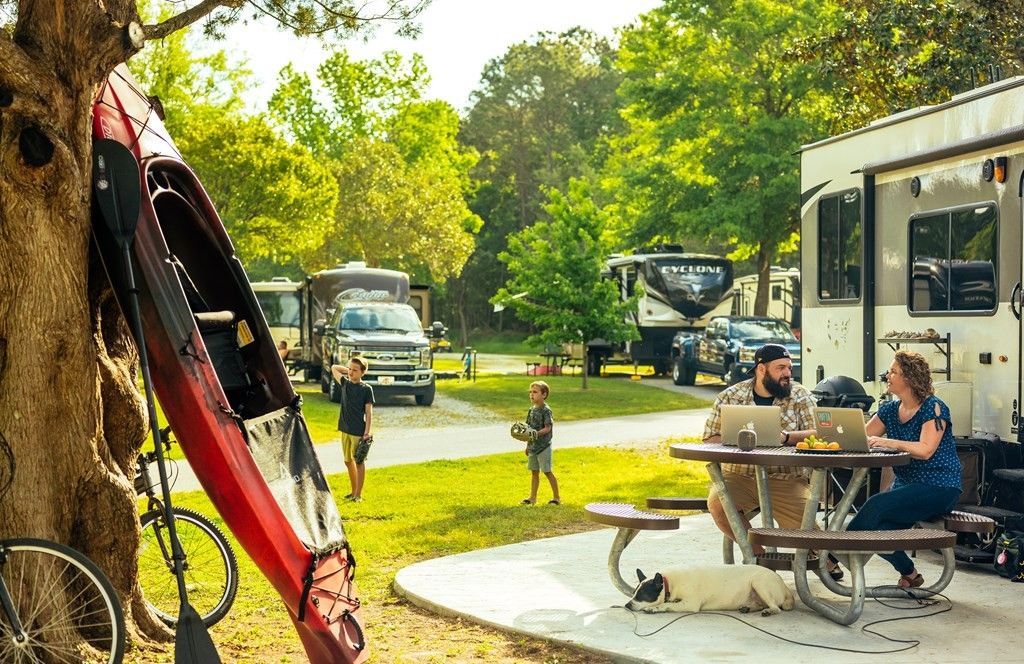
This is the most straightforward option.
You keep a traditional job, just not a traditional office.
Remote roles now exist in:
- Customer service
- Sales
- Marketing
- Tech
- Accounting
- Project management
- Healthcare administration
The benefits:
- Predictable income
- Benefits (in many cases)
- Less financial uncertainty
The tradeoff:
- You’re still working set hours
- Travel may need to revolve around your schedule
For some families, this is the cleanest solution.
Freelancing with Recurring Clients
Freelancing can become a full-time income if structured correctly.
Instead of one-off gigs, focus on:
- Monthly retainers
- Ongoing services
- Long-term contracts
Examples:
- Managing YouTube channels
- Running ads
- SEO services
- Bookkeeping
- Copywriting
With just 3–5 consistent clients, you can build a stable monthly income while maintaining location freedom.
Affiliate Marketing
This model allows you to earn commissions by recommending products or services.
It can be done through:
- Blogging
- YouTube
- Email marketing
- Niche websites
The upside:
- High scalability
- Recurring commissions in some niches
- Long-term passive income potential
The downside:
- It takes time to build
- Income can fluctuate early on
This works best for RVers who are willing to build something over the long term rather than needing immediate cash flow.
Content Creation (YouTube, Social Media, Blogging)

Some RVers document:
- Travel
- Campground reviews
- RV upgrades
- Cost breakdowns
- Full-time lifestyle experiences
Income can come from:
- Ad revenue
- Brand partnerships
- Affiliate links
- Digital products
This can grow into a full-time income, but it rarely happens overnight.
It’s a long game built on consistency.
E-Commerce
Some RVers run:
- Amazon FBA businesses
- Print-on-demand stores
- Private label brands
- Niche product stores
This model requires:
- Inventory management (or fulfillment partners)
- Customer service systems
- Cash flow management
It’s scalable.
But it requires structure and planning.
6. Online Coaching, Consulting, or Courses
If you have expertise in:
- Fitness
- Business
- Marketing
- Finance
- Trades
- Education
You can package that into:
- Coaching programs
- Digital courses
- Paid memberships
This model can generate high income, especially if you already have credibility or an audience.
The Full-Time Income Reality
When you need full replacement income, you’re building a system.
Not just picking up gigs.
The most successful full-time RV earners usually have:
- Predictable baseline income
- Plus scalable upside
For example:
- Remote job + affiliate marketing
- Freelancing + digital products
- Content creation + brand partnerships
Blending models reduces risk.
Comparing Stability, Freedom & Scalability
Not all income streams are created equal.
Some give you stability.
Some give you flexibility.
Some give you long-term upside.
Very few give you all three right away.
Here’s a simple breakdown to help you think through the tradeoffs:
| Income Type | Flexibility | Stability | Scalability |
| Workamping | High | Low | Low |
| Seasonal Jobs | Medium | Low | Low |
| Remote Employment | Medium | High | Low |
| Freelancing | Medium | Medium | Medium |
| Affiliate Marketing | High | Low (early) | High |
| Content Creation | High | Low (early) | High |
| E-Commerce | Medium | Medium | High |
| Coaching / Courses | High | Medium | High |
What This Really Means
- Workamping offers freedom but not income growth.
- Remote jobs provide stability but not time freedom.
- Freelancing sits in the middle, stable if structured well.
- Online businesses are unstable at first, but highly scalable over time.
The biggest mistake people make is assuming they must pick just one.
Most full-time RVers who make it work long-term combine models:
- Remote job + side business
- Freelance income + digital product
- Seasonal work + online income
- Pension + affiliate marketing
You don’t need the perfect model.
You need something that fits:
- Your skill set
- Your risk tolerance
- Your desired travel pace
And most importantly… your income requirement.
What Most Full-Time RVers Don’t Realize About Making Money on the Road
Many people assume the hard part is finding “the right job.”
It usually isn’t.
The hard part is understanding that RV life doesn’t magically reduce your need for income. It just changes the structure of your expenses.
If you travel frequently, stay in resort-style parks, finance a newer rig, and eat out often, your costs can rival those of traditional homeownership. In some cases, they can exceed it.
If you travel slowly, mix in boondocking, choose simple campgrounds, and own your RV outright… your income requirement drops significantly.
The lifestyle is flexible.
Your financial structure must be flexible as well.
Another thing people don’t realize is that you don’t need a dream business. You need a predictable cash flow.
There’s a big difference.
Predictable cash flow pays for insurance, fuel, groceries, and maintenance. It keeps stress low. It lets you enjoy the places you worked so hard to reach.
Trying to build something flashy or trendy without understanding your monthly numbers creates pressure. Pressure turns into rushed decisions. Rushed decisions usually don’t end well.
Most long-term full-time RVers blend income streams. They don’t rely on one fragile source. They build layers.
Maybe it starts with a remote job. Then a small side business grows in the background. Over time, that side income may become the primary income.
Or maybe seasonal work funds several months of slow travel while an online income stream grows quietly in the background.
It’s rarely all or nothing.
And the people who stick with this lifestyle usually manage their income the same way they manage their travel plans: intentionally, adaptively, and realistically.
How to Decide What’s Right for You

At some point, you have to move from researching ideas to making a decision.
And the right choice has less to do with what’s trending… and more to do with your personality, your season of life, and your financial reality.
Start with your number.
How much do you actually need each month to feel comfortable? Not optimistic. Not the best-case scenario. Comfortable.
Then ask yourself how much risk you’re willing to tolerate.
If you need stability and low stress, a remote job or consistent freelance clients might be the right move. It may not feel glamorous, but a predictable income creates freedom in other areas.
If you’re comfortable with uncertainty and willing to build something long-term, an online business model like affiliate marketing, content creation, or digital products might make sense. Just understand that these take time. They require consistency. And they usually don’t pay immediately.
You also need to consider how you want your days to look.
Do you want to set work hours and clear boundaries between work and travel? Or do you prefer flexible hours with more responsibility and variability?
Some RVers enjoy a structured work schedule, then fully unplugging. Others prefer blending work and travel throughout the week.
There isn’t a right answer. There’s just alignment.
Finally, be honest about your skills.
If you already have experience in accounting, marketing, design, education, trades, or management, lean into that first. Building income from existing strengths is far faster than reinventing yourself from scratch.
You can always expand later.
The goal isn’t to find the perfect income stream on day one.
It’s to choose something sustainable enough to support your version of RV life.
Final Thoughts: RV Life Isn’t Free, But It Can Be Flexible
Full-time RV living isn’t automatically cheaper.
It isn’t automatically easier either.
But it is adaptable.
That’s what makes it powerful.
You can structure your travel pace around your income.
Or structure your income around your travel pace.
You can reduce expenses to lower your income requirement.
Or increase income to expand your options.
There isn’t one correct way to fund this lifestyle.
Some people work seasonal jobs and travel the rest of the year.
Some hold steady remote careers.
Some build online businesses slowly and deliberately.
Many combine multiple streams so they’re not relying on a single fragile source.
The key is understanding your numbers, choosing a realistic income model, and building something that supports the way you actually want to live.
RV life rewards intentional decisions.
When your income plan aligns with your travel plan, your lifestyle becomes sustainable rather than stressful.
And that’s when the freedom people talk about actually starts to feel real.
FAQ: Making Money as a Full-Time RVer
How do full-time RVers make money?
Full-time RVers make money in a variety of ways, including remote jobs, freelancing, workamping, seasonal jobs, affiliate marketing, content creation, e-commerce, and online businesses. Some rely on part-time income to offset travel costs, while others build a full replacement income to support the entire lifestyle.
Can you really work remotely while living in an RV?
Yes, many full-time RVers work remotely. Reliable internet, careful route planning, and selecting campgrounds with strong connectivity enable remote employment. Many RVers maintain traditional remote jobs in fields such as customer service, marketing, technology, accounting, and project management.
How much money do you need to live in an RV full-time?
The amount varies depending on travel style and financial obligations. Some RVers live comfortably on $2,000–$3,000 per month by traveling slowly and keeping expenses low. Others may need $5,000–$8,000 or more per month if they have an RV payment, travel frequently, or stay in resort-style RV parks.
Is RV living cheaper than owning a home?
It can be, but it isn’t guaranteed. RV living costs depend on factors like campground fees, fuel, maintenance, insurance, and how often you move. Slower travel and boondocking can significantly reduce expenses, while fast travel and premium parks can increase them.
What are the best jobs for full-time RVers?
The best jobs for full-time RVers are those that offer flexibility and predictable income. Remote employment, recurring freelance work, affiliate marketing, content creation, and digital products are common options. Seasonal jobs and workamping are popular among those who need only part-time income.

Lauren Gamble is a wife, mother, and seasoned entrepreneur with a background in digital, affiliate marketing, and content creation. She and her husband run multiple remote businesses that give their family the freedom to live and travel full-time in their RV. As a homeschooling mom, Lauren is passionate about creating a life rich in experiences and connection. Through Time to RV, she shares her family’s journey, along with practical insights, travel tips, and resources to help others explore the road less traveled, without sacrificing stability or success. Lauren and her family have been full-time RVing since November 2024.
How We Review: At Time to RV, we only recommend products and places we have personally used or visited. Our reviews are based on real-life testing during our full-time travels. We never accept payment for a positive review; our goal is to give you the honest truth so you can hit the road with confidence.